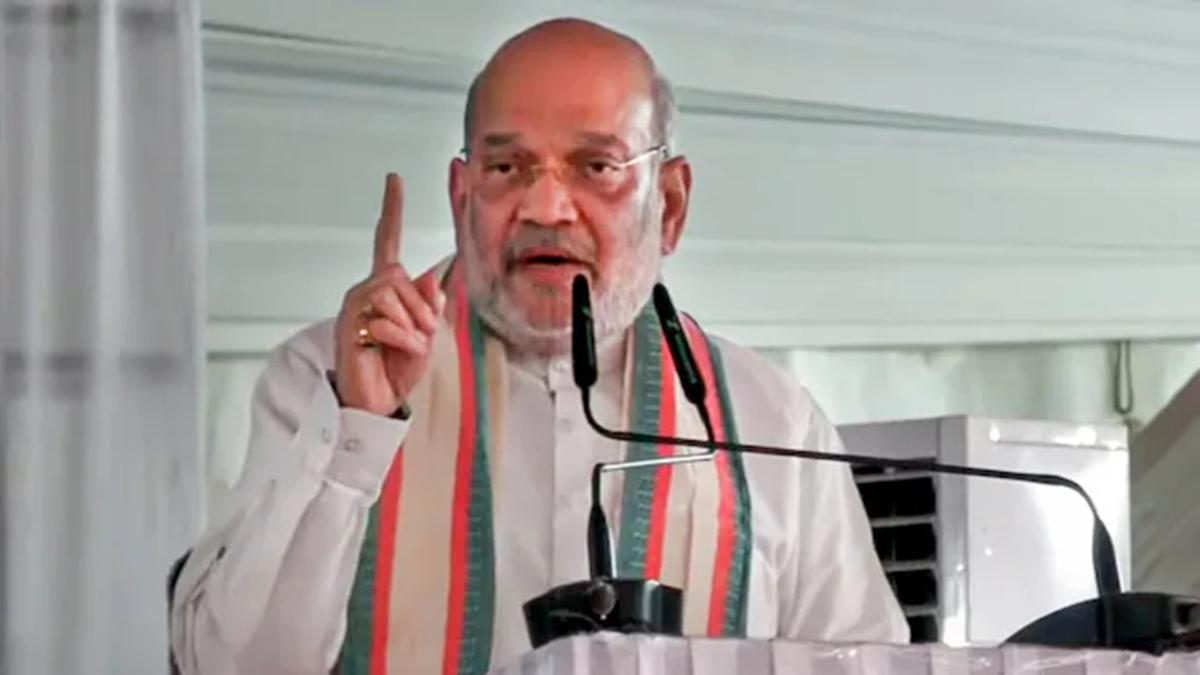
In a bold declaration with significant geopolitical implications, Union Home Minister Amit Shah has confirmed that India will not restore the Indus Waters Treaty (IWT) with Pakistan, declaring that the country will instead utilize the river water for its own development, particularly in water-scarce regions like Rajasthan.
“No, it will never be restored,” Shah stated emphatically in an interview, ending speculation about a possible resumption of the six-decade-old treaty that has governed water sharing between the two neighbours since 1960.
The Home Minister also revealed that the Indian government is preparing to construct a canal to reroute the water currently flowing to Pakistan, a move that signals a strategic and symbolic shift in India’s approach to its western neighbour.
“We will take water that was flowing to Pakistan to Rajasthan by constructing a canal. Pakistan will be starved of water that it has been getting unjustifiably,” Shah said.
The Indus Waters Treaty, brokered by the World Bank in 1960, allocated control of the eastern rivers (Ravi, Beas, Sutlej) to India and the western rivers (Indus, Jhelum, Chenab) to Pakistan, with India allowed limited use. However, the Indian government suspended the pact following the April 22 terrorist attack in Pahalgam, Jammu and Kashmir, in which 26 civilians were killed. India linked the suspension to Pakistan's continued support for cross-border terrorism.
Despite Islamabad's repeated denials of involvement and its continued appeals for the treaty's restoration, India has maintained its hardline stance, firmly stating that “talks and terror cannot go together.”
According to Indian officials, Pakistan’s Water Resources Secretary Syed Ali Murtaza has written multiple letters to India’s Jal Shakti Ministry, seeking dialogue on treaty compliance. Three of those communications reportedly came after Operation Sindoor, India’s military response to the Pahalgam killings.
India’s official response was delivered on April 24, with Water Resources Secretary Debashree Mukherjee emphasizing that treaty obligations must be honoured in good faith, and accusing Pakistan of violating that principle by backing terror outfits.
“What we have seen instead is sustained cross-border terrorism by Pakistan targeting the Indian Union territory of Jammu and Kashmir,” the letter read.
While critics warn of the diplomatic fallout and the risks of water being used as a strategic weapon, supporters of the move argue that national interest and internal security must take precedence. The construction of the canal to divert water is expected to provide much-needed relief to drought-prone areas in western India.
As South Asia grapples with climate challenges and water scarcity, this marks a historic shift in India's water diplomacy, signalling that New Delhi will no longer remain passive in the face of terror, and that strategic resources like river water may now be leveraged as part of a broader security doctrine.