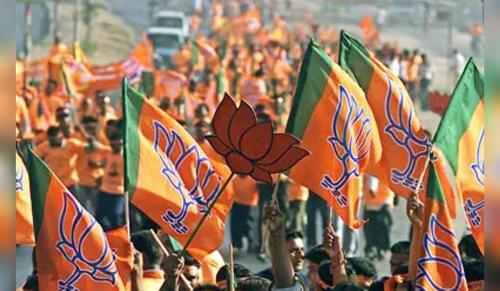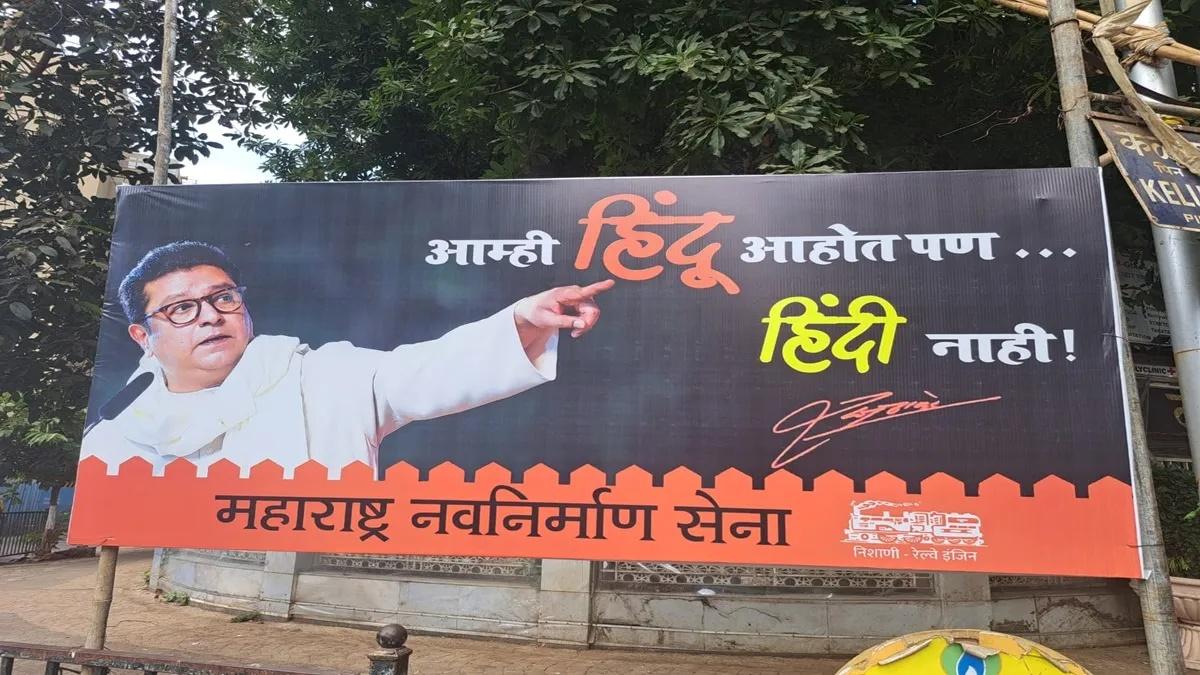
The Marathi versus Hindi language debate in Maharashtra has reignited after the Maharashtra Navnirman Sena (MNS), led by Raj Thackeray, intensified its opposition to the state government’s decision to implement Hindi as a mandatory third language in schools. The party launched a protest campaign by putting up striking posters in Dadar—a Marathi-majority locality in Mumbai—declaring, “Hum Hindu Hain, Lekin Hindi Nahi” (We are Hindus, but not Hindi).
These posters have stirred political discourse and reflect the growing discontent among Marathi-speaking communities, who believe that the regional language is being sidelined in favour of Hindi. The MNS has warned of a strong agitation if the decision is not withdrawn and held the BJP-led state government responsible for the consequences.
Raj Thackeray, in a sharp critique posted on social media, lashed out at the government's directive to make Hindi compulsory from Class 1 under the State School Curriculum Plan 2024. He made it clear that his party would strongly oppose this imposition, asserting that the move is part of a larger agenda to ‘Hindi-nize’ the nation, which he believes is unacceptable in a linguistically diverse state like Maharashtra.
Thackeray emphasized that Hindi is not the national language but a state language like others and questioned the rationale behind making it compulsory in the early years of schooling. He argued that the three-language formula should be confined to administrative functions and not be enforced in the education sector.
The controversy erupted after the Maharashtra government, aligning with the National Education Policy (NEP) 2020, announced the implementation of a new curriculum where Hindi will be a compulsory third language from Class 1 to Class 5 in all state board schools. According to an official Government Resolution, the phase-wise rollout will begin in the academic year 2025–26, starting with Class 1.