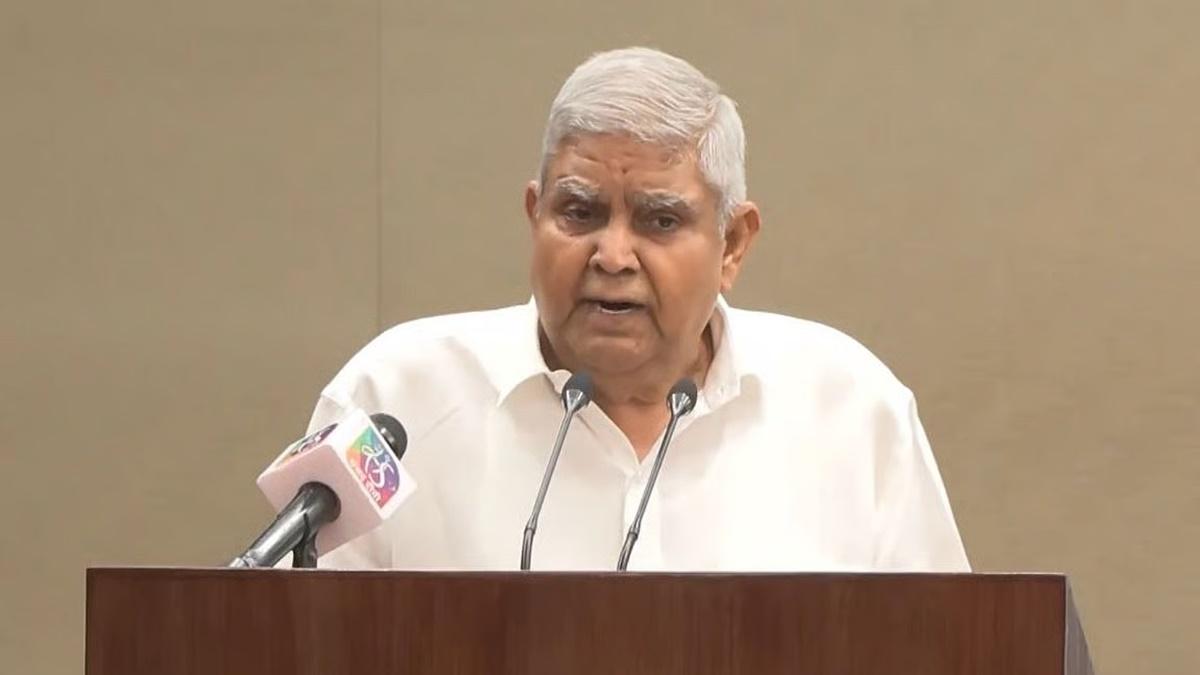
In a blistering critique of the judiciary, Vice President Jagdeep Dhankhar on Thursday lashed out at the Supreme Court, stating unequivocally that “we cannot have a situation where courts direct the President.” His sharp remarks come shortly after the apex court passed a landmark judgment effectively setting a deadline for the President and Governors to clear pending Bills—an act that Dhankhar viewed as judicial overreach.
Speaking at the Valedictory Function of the 6th Rajya Sabha Internship Program at the Vice-President’s Enclave, Dhankhar said that Article 142, which empowers the Supreme Court to pass orders for “complete justice,” has evolved into “a nuclear missile against democratic forces, available to the judiciary 24x7.”
The Vice President didn’t stop there. Referencing a major controversy, he recounted the incident involving the recovery of a huge amount of cash from the residence of a sitting Delhi High Court judge on the night of March 14–15. “For seven days, no one knew about it… Is the delay explainable? Condonable?” Dhankhar questioned, pointing out that it wasn’t until a March 21 newspaper report that the public became aware. “The people of the country were shocked as never before,” he remarked.
He further questioned the institutional silence and delay, saying, “It is now over a month. Even if it is a can of worms. Even if there are skeletons in the cupboard, time to blow up the can. Time for its lid to go out. And time for the cupboard to collapse. Let the worms and skeletons be in public domain so that cleansing takes place.”
Addressing legal immunity granted to judges, Dhankhar criticized the special procedure required to file an FIR against members of the judiciary. “An FIR in this country can be registered against anyone—any constitutional functionary, including the one before you. No permission is required. But if it is judges—FIR cannot be straightaway registered. It has to be approved by the concerned in judiciary. But that is not given in the Constitution,” he pointed out.