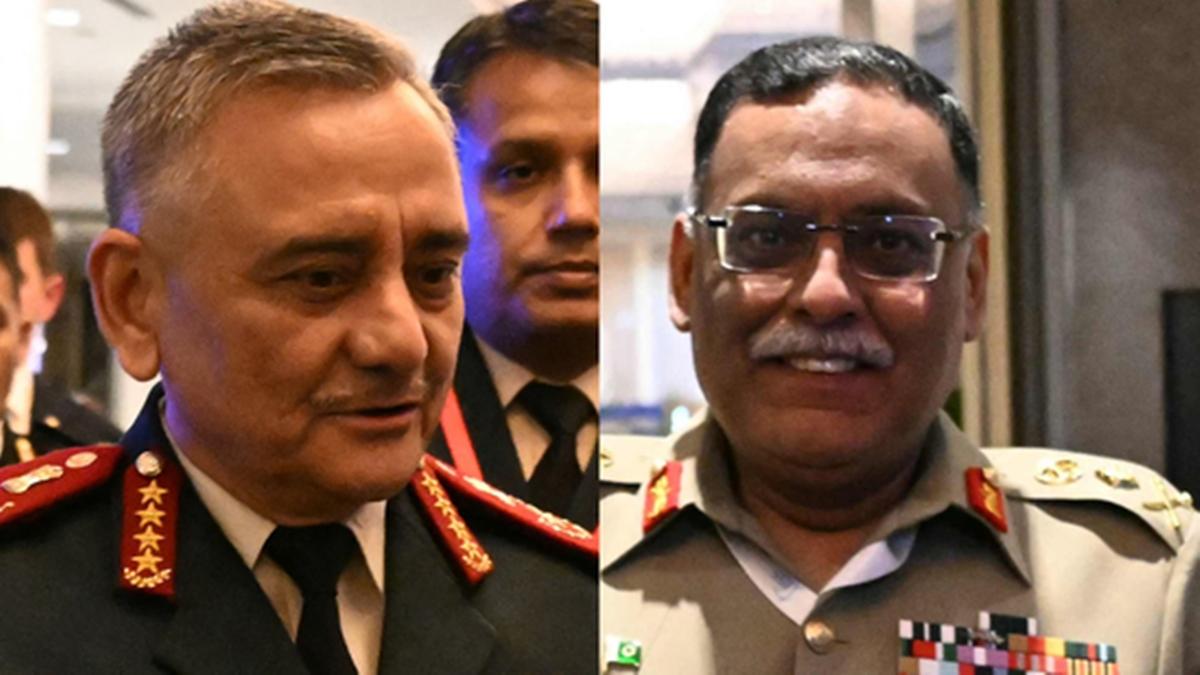
At the prestigious Shangri-La Dialogue in Singapore, a global security forum attended by key military leaders from around the world, India and Pakistan’s top generals delivered sharp, contrasting messages that underlined the rising tensions between the two nuclear-armed neighbours.
In back-to-back panel sessions on Saturday afternoon, Chief of Defence Staff (CDS) General Anil Chauhan of India and Pakistan’s Chairman of the Joint Chiefs of Staff Committee General Sahir Shamshad Mirza indirectly traded barbs on terrorism, military escalation, and the long-standing Kashmir dispute.
Addressing India's recent military operation — codenamed Operation Sindoor, which targeted terror camps in Pakistan and Pakistan-occupied Kashmir (PoK) — General Chauhan declared: “What India has done, politically, they have drawn a new red line of intolerance against terror.”
He went on to assert India’s firm stance: “I hope this particular operation, it is basically lying in military domain, that should bring about some lessons for our adversary also, and hopefully they learn that this is a limit of India's tolerance,”
(PTI quoted Anil Chauhan as saying).
Referring to India’s long-standing battle with cross-border terrorism, Chauhan added, “We have been subjected to this proxy war of terror for almost two decades and more, and we lost lot of people... we want to put an end to it.”
The remarks came in the backdrop of the April 22 Pahalgam terror attack in Jammu and Kashmir, which killed 26 tourists. India has blamed Pakistan-based terror groups for the attack, a charge Islamabad has categorically denied.
A Call for Resolution from Pakistan
In a parallel session titled “Regional Crisis-Management Mechanisms,” General Sahir Shamshad Mirza of Pakistan advocated for a shift from mere crisis management to actual conflict resolution. He emphasized that unresolved disputes, especially Kashmir, could spiral into dangerous escalations.
“It has become imperative to move beyond conflict management towards conflict resolution. This will ensure sustainable peace and assured crisis management,” he said, (as reported by PTI).
Calling for an "early resolution of Kashmir" in line with UN Security Council resolutions and “aspirations of the people,” Mirza warned that the absence of a formal mechanism for crisis management could lead to catastrophic outcomes.
“Given the Indian policies... the absence of a crisis management mechanism may not give enough time to the global powers to intervene and affect cessation of hostilities. They will probably be too late to avoid damage and destruction,” he cautioned.
General Mirza repeatedly raised the Kashmir issue during his address: “The core that resides between Pakistan and India is Kashmir. When there is no crisis, Kashmir is never discussed... it is the Kashmir dispute resolution that will address many issues.”
On Strategic Stability and Escalation Risk
Warning about a reduced threshold for war, General Mirza noted: “Following the military conflict, the threshold of an escalatory war has come dangerously low, implying greater risk on both sides, not just in the disputed territory but all of India and all of Pakistan.”
He also accused the West of emboldening India: “Emboldening of India as a net security provider by the West and its ambition to become a regional hegemon is disincentivising it to engage in conflict management options.”
Details of Operation Sindoor
India’s Operation Sindoor, launched on May 7, was a direct response to the Pahalgam attack. Over four days, India targeted and destroyed nine terror infrastructure facilities located in Pakistan and PoK. The operation concluded on May 10 following an informal understanding between the two sides to halt further military action.
General Mirza claimed that the United States, the United Kingdom, Turkiye, China, Saudi Arabia, and the UAE acted as behind-the-scenes interlocutors during the conflict.