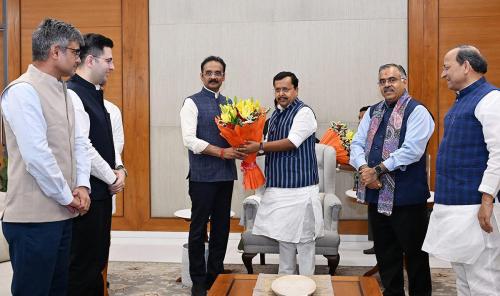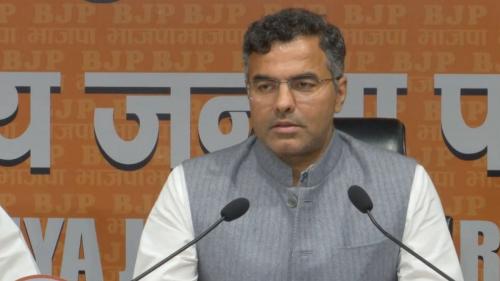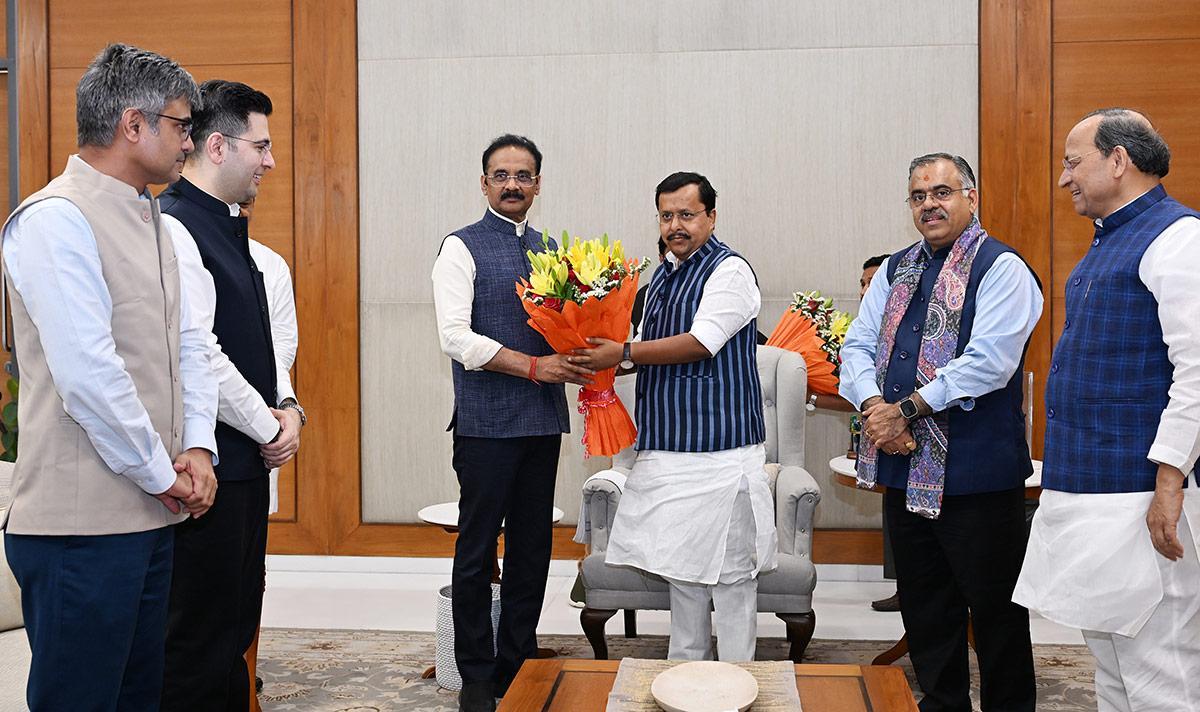
The political storm triggered after seven Rajya Sabha MPs left the Aam Aadmi Party and joined the Bharatiya Janata Party has turned into a high-stakes confrontation between political demands and constitutional limits.
Punjab Chief Minister Bhagwant Mann is preparing to meet President Droupadi Murmu along with a delegation of AAP MLAs, arguing that the MPs’ exit violates the mandate given by Punjab’s voters in the 2022 Assembly elections. The party is framing the issue as a breach of public trust and is demanding what it calls a “right to recall” of the defected leaders.
The MPs at the centre of the controversy include Raghav Chadha and Sandeep Pathak, along with five others who have switched sides and joined the BJP, significantly weakening AAP’s position in the Rajya Sabha.
AAP’s core argument is that these MPs were elected through votes linked to the party’s mandate in Punjab, and therefore their defection undermines the will of the electorate. However, constitutional experts point out that Indian law does not support this interpretation.
There is no legal provision in India for the recall of Members of Parliament or state legislators once elected. The Constitution does not recognise a “Right to Recall” at the national or state level. MPs can only be removed through resignation, disqualification under law, or court conviction.
Even the President of India has no authority to recall or dismiss elected MPs, making AAP’s demand largely symbolic in legal terms.
The only relevant legal framework in this case is the anti-defection law under the Tenth Schedule of the Constitution. AAP is expected to approach Rajya Sabha Chairman C. P. Radhakrishnan seeking disqualification of the defectors.
However, the situation is complicated by the “merger clause” of the anti-defection law, which allows legislators to switch parties without losing their seats if at least two-thirds of a party’s members support the move. In this case, reports suggest that seven out of AAP’s ten Rajya Sabha MPs have defected together, potentially meeting the legal threshold that protects them from disqualification.
While recall is not available for MPs or MLAs, a limited form of recall does exist at the local governance level in India. In some states, elected representatives like sarpanches and municipal officials can be removed through no-confidence motions. However, this system has never been extended to Parliament or state assemblies.
Despite the legal constraints, AAP’s political messaging is aimed at building public pressure. Bhagwant Mann’s proposed meeting with the President is being viewed as an attempt to transform a legal setback into a political narrative ahead of the 2027 Punjab elections.
For now, the legal route remains narrow. The real decision-making power lies with the Rajya Sabha Chairman, who will determine whether the defecting MPs fall under anti-defection provisions or are protected by the merger clause.