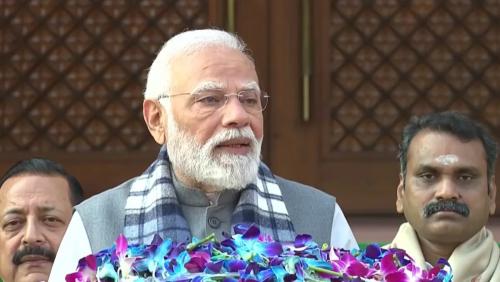
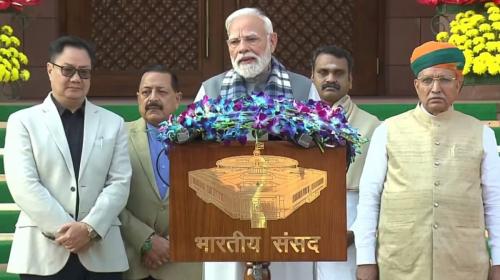
A day before Parliament’s Winter Session begins on December 1, the government convened an all-party meeting in New Delhi on Sunday, presenting a detailed list of 14 key bills it intends to introduce during the short but politically significant session. The agenda spans critical policy areas including atomic energy, higher education reforms, taxation changes, corporate regulation, and national highways.
According to information shared in the meeting, the legislation planned for introduction includes the Atomic Energy Bill 2025, Higher Education Commission of India Bill 2025, Jan Vishwas (Amendment of Provisions) Bill 2025, and the Insolvency and Bankruptcy Code (Amendment) Bill 2025. Financial and regulatory matters feature prominently with the Securities Markets Code Bill 2025, Insurance Laws (Amendment) Bill 2025, Arbitration and Conciliation (Amendment) Bill 2025, and the Corporate Laws (Amendment) Bill 2025. The agenda also lists the Manipur GST Second Amendment Bill 2025, Central Excise (Amendment) Bill 2025, Repealing and Amending Bill 2025, National Highways (Amendment) Bill 2025, the Health Security and National Security Cess Bill 2025, and the ordinance-replacing Manipur GST amendment for passage.
Even as the government outlined its legislative priorities, Opposition leaders expressed sharp dissatisfaction with the duration of the upcoming session, accusing the Centre of limiting parliamentary oversight. They signaled that issues such as the Special Intensive Revision of electoral rolls, the recent blast in Delhi, environmental challenges, foreign policy concerns, and national security would be raised strongly on the floor of the House.
Congress MP Gaurav Gogoi criticized the shortened schedule, telling India Today that with only 15 effective sittings planned, “it seems the government itself wants to derail Parliament,” adding that the Centre was “burying the entire parliamentary decorum”.
Parliamentary Affairs Minister Kiren Rijiju responded by urging political parties to cooperate and maintain order, saying that lawmakers should “work with a cool head and avoid heated exchanges”.
The government delegation at the meeting included Defence Minister Rajnath Singh, BJP president JP Nadda, Parliamentary Affairs Minister Kiren Rijiju, and MoS Arjun Ram Meghwal. Representing the Opposition were leaders from the Congress, DMK, Trinamool Congress, RJD, and IUML.