In a revelation that has ignited a fresh wave of political outrage, the government has disclosed in the Rajya Sabha that Prime Minister Narendra Modi’s foreign visits between 2021 and 2025 have cost the exchequer a staggering ₹362 crore, with over ₹67 crore spent on international travel in 2025 alone. The figures were shared by Minister of State for External Affairs Kirti Vardhan Singh in response to a query raised by Trinamool Congress MP Derek O'Brien.
The most expensive trip this year was to France, which alone incurred a cost of over ₹25 crore, followed by the United States, where the Prime Minister’s visit cost ₹16 crore. The remaining visits to Mauritius, Cyprus, and Canada are yet to be fully accounted for, according to the official records.
The disclosure has triggered sharp criticism from Opposition parties, who accuse the government of lavish spending amid pressing domestic crises.
“While farmers are protesting for MSP, youth are jobless, and inflation is squeezing the middle class — the PM is globe-trotting at public expense,” a senior Congress leader said.
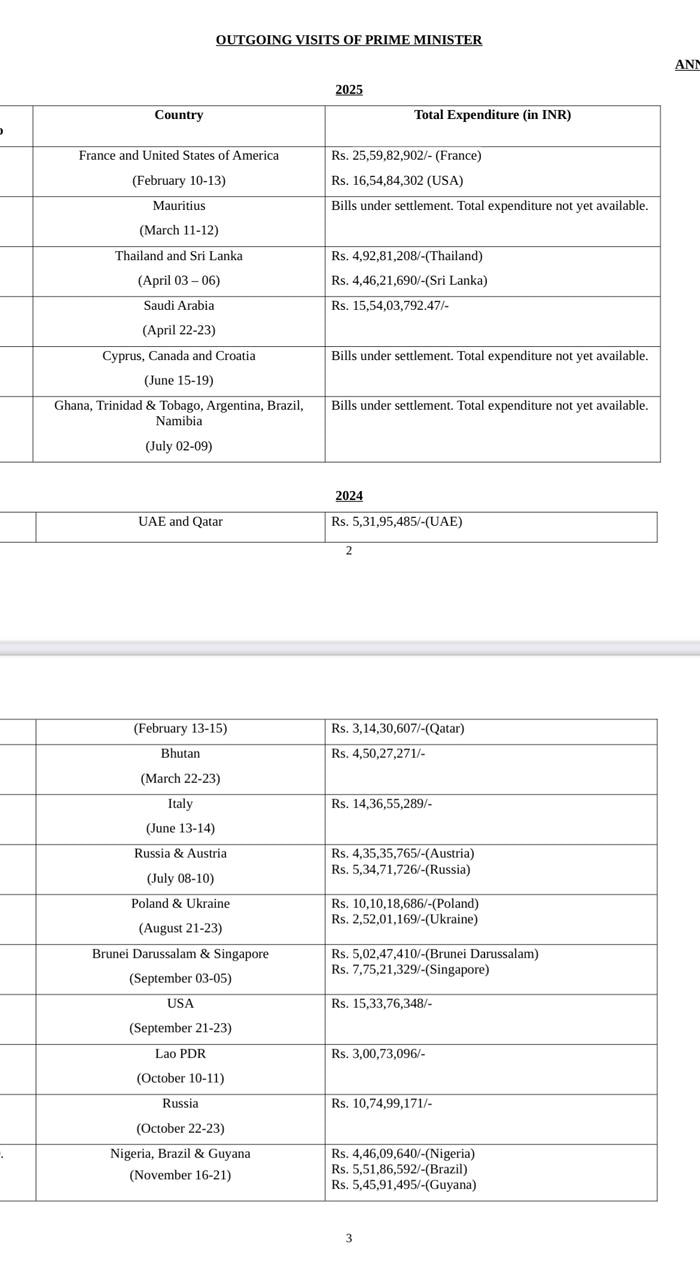
The year-wise breakup of the expenditure paints a clear picture of escalating travel costs:
2021 – ₹36 crore
2022 – ₹55.82 crore
2023 – ₹93 crore
2024 – ₹109 crore
2025 (till date) – ₹67+ crore
In 2024, 16 foreign visits, including those to Russia and Ukraine, totaled ₹109 crore. In 2023, nearly ₹93 crore was spent, including ₹22 crore on the US visit alone, during which Modi met then-President Donald Trump. The 2022 visits to Germany and Japan cost over ₹9 crore and ₹8 crore, respectively.
Even Modi’s 2021 visit to the United States cost over ₹19 crore, while trips to Bangladesh, Italy, and the UK further added to the rising tally.
The official data also includes public engagement, advertising, and broadcasting costs, raising eyebrows over the government’s communications-heavy diplomacy model. For example, ₹11.90 lakh was spent on advertising during Modi’s 2023 visit to Egypt.
While the government defends these trips as “strategic engagements” for national interest, trade deals, and geopolitical alignment, critics argue that such vast spending lacks accountability and contrasts sharply with the tightening of welfare budgets at home.