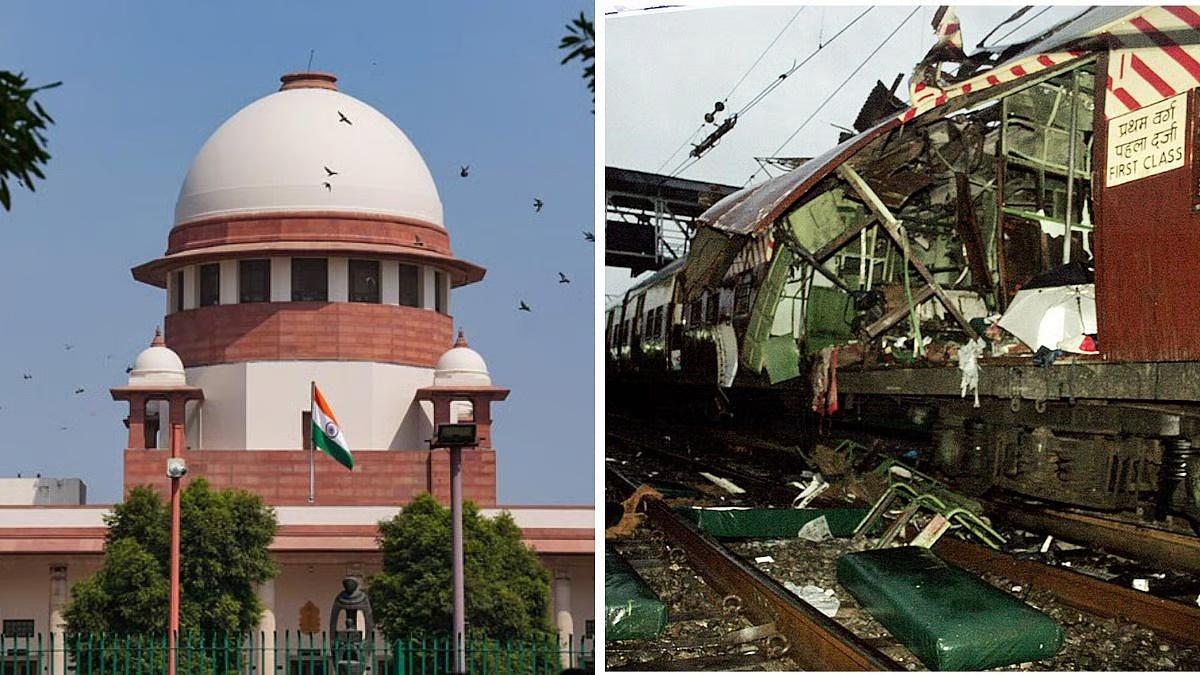
In a significant observation during a high-profile hearing, the Supreme Court on Wednesday remarked that a stay on acquittal is permitted only in the “rarest of rare” circumstances. The remark came while the bench, led by Chief Justice of India D.Y. Chandrachud and comprising Justice B.R. Gavai, took up the Maharashtra Government’s plea challenging the Bombay High Court's recent acquittal of 12 men accused in the 2006 Mumbai train bombings.
Chief Justice Gavai questioned the urgency of the plea, noting, “But what’s the hurry? Eight of them are already out. Stay on acquittal is the rarest of rare.” This was in response to the state’s repeated push for immediate hearing of the case.
On Tuesday, Solicitor General Tushar Mehta, representing the Maharashtra Anti-Terrorism Squad (ATS), had urged the court to list the matter on priority, citing national security and the seriousness of the charges. While the court had agreed to hear the plea, the state once again mentioned the case on Wednesday, highlighting a technical flaw in the petition — a portion of the High Court judgment was quoted in Hindi. Despite the defect, the state’s counsel urged the court to continue with the hearing, saying, “We might be able to convince the court that this case is the rarest of rare.”
The Bombay High Court had earlier overturned the 2009 verdict of a special trial court which had sentenced five of the 12 accused to death and the others to life imprisonment. The High Court, in its strongly worded judgment, criticized the prosecution for its failure to substantiate the charges. Justices Anil Kilor and Shyam Chandak pointed out serious lapses such as unreliable witness testimonies, flawed identification procedures, and accusations of custodial torture.
Among the most damning findings was that some witnesses had remained silent for years and later came forward to identify the accused, while others had appeared in multiple unrelated terror cases. The court also flagged discrepancies in the chain of custody of recovered explosives, including RDX.
The July 11, 2006, train bombings were one of India’s deadliest terrorist attacks, with seven coordinated blasts on Mumbai’s suburban Western Railway network during peak evening hours. The attacks killed 189 people and injured over 800, sparking one of the largest anti-terror investigations in the country’s history.