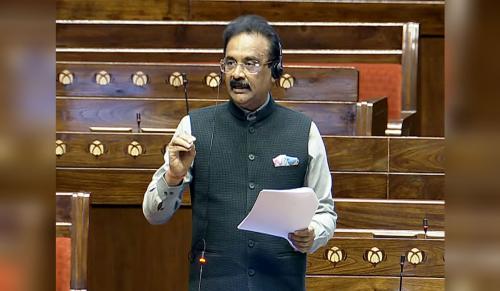
In a dramatic address in the Lok Sabha, Congress leader Rahul Gandhi drew a striking parallel between ancient Indian warfare and contemporary political dynamics, accusing the current central leadership of orchestrating a "Chakravyuh" that he claims is devastating the country. His comments sparked a heated debate and drew sharp responses from various quarters.
Speaking to a packed House, Gandhi likened the present political and economic situation to the "Chakravyuh" from the Mahabharata, a formidable military formation used to trap Abhimanyu. He said, "Thousands of years ago, in Kurukshetra, six people trapped Abhimanyu in a 'Chakravyuh' and killed him. I did a little research and found out that 'Chakravyuh' is also known as 'Padmavuyh'?which means 'Lotus formation'. 'Chakravyuh' is in the shape of a Lotus. In the 21st century, a new 'Chakravyuh' has been formed?that too in the form of a Lotus. Prime Minister wears its symbol on his chest."
Gandhi further alleged, ?What was done with Abhimanyu is being done with India?the youth, farmers, women, small and medium businesses. Today, too, there are six people in the center of the 'Chakravyuh'?Narendra Modi, Amit Shah, Mohan Bhagwat, Ajit Doval, Ambani, and Adani."
The statement drew an immediate reaction from Speaker Om Birla, who intervened, asking Gandhi to either omit the names of certain individuals or provide a more focused critique. Gandhi responded by narrowing his critique: ?The 'Chakravyuh' that has captured India has three forces behind it. First, the idea of monopoly capital?where two people are allowed to own the entire Indian wealth. Second, the institutions and agencies like the CBI, ED, and IT. Third, the political executive. These three elements together are at the heart of the 'Chakravyuh' and they have devastated this country.?
This bold statement has reignited discussions about the influence of big business and the concentration of power in Indian politics. Critics have argued that Gandhi?s comments are politically charged, aiming to highlight perceived mismanagement and corruption within the current government. Supporters, however, believe his critique underscores the growing concerns about economic disparity and institutional integrity.