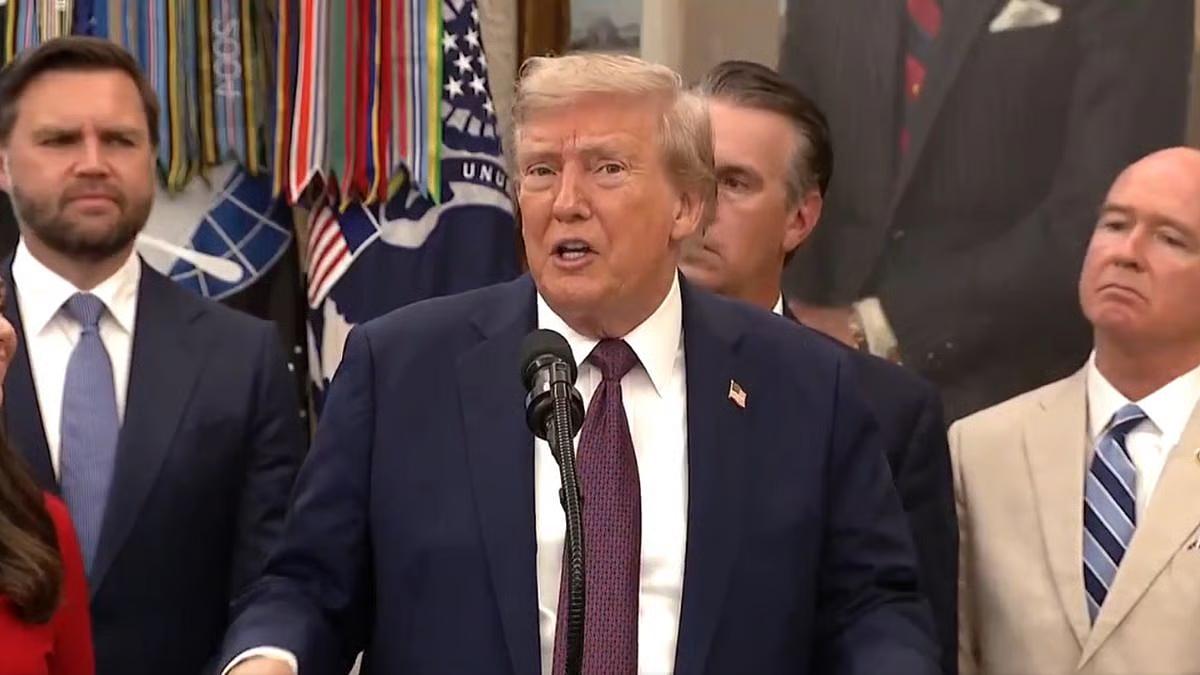
US President Donald Trump on Tuesday (local time) defended his tariff strategy, calling it a powerful tool for negotiations and claiming it strengthened Washington’s global leverage. Speaking during the announcement of the US Space Command headquarters move to Huntsville, Alabama, Trump described tariffs as an instrument that not only boosted the US economy but also helped him “settle seven wars.”
Trump criticized the Biden administration, asserting that the progress made during his first term had slowed under the current government. “Without the United States, everything in the world would die. It's so powerful. And I made it really big in the first four years. Then it started to degenerate with what this Biden administration did. But we've built it up to a level that I never thought we could be at this quickly. We're the hottest. We're the best financially. The money coming in is so big because of tariffs and other things, but because of tariffs. Tariff gets us even those other things. Plus, it makes us great negotiators,” he said.
He emphasized that tariffs had played a key role in his foreign and trade policies. “I settled seven wars and numerous of those wars were because of trade. And numerous of the trade deals that I made were because of tariffs. It gives you a great negotiating ability,” Trump added.
Turning to India-US trade relations, Trump justified the imposition of a 50 percent tariff on Indian imports, arguing that the trade relationship had been one-sided for many years. “India was charging us tremendous tariffs. They were the highest in the world… So they sent in everything they made and poured it into the country… But we would not send in anything, as they were charging us with 100 percent tariffs,” he said.
Trump cited the example of Harley Davidson, explaining how high tariffs on motorcycles had hindered American business in India. “Harley Davidson couldn’t sell in India, as there was a 200 percent tariff on a motorcycle… Harley Davidson went to India and built a motorcycle plant, and now they don’t have to pay tariffs,” he noted.